Antennas for an RTL-SDR stick beyond the kit dipole: the dipole set, a discone for wideband listening, a 1090 MHz antenna for aircraft, plus an FM broadcast stop filter and an LNA.
Alcuni link in questa pagina sono link affiliati AliExpress. Se acquisti tramite questi link potremmo ricevere una piccola commissione, senza alcun costo aggiuntivo per te. Il prezzo che paghi non cambia mai, ed elenchiamo solo attrezzatura che useremmo davvero con un ATS Mini.
An RTL-SDR stick has a 50-ohm SMA input, unlike the ATS Mini’s high-impedance whip input, so it wants proper antennas fed with coax. One antenna cannot do everything from shortwave to 1.7 GHz well. Pick for what you want to hear, and put the antenna as high and as far from the house wiring as you can: a mediocre antenna outside beats a good one next to a monitor. For shortwave, the longwire, loops and active antennas on the antennas page also suit a stick (look for the RTL-SDR tag), and the HF guide explains how the stick reaches HF.
Start with the dipole kit
The RTL-SDR Blog dipole kit is a set of telescopic and short elements on a small mount, with a coax lead and a suction-cup holder. Extend each arm to about a quarter wavelength (in centimetres, roughly 7100 divided by the frequency in MHz) and it covers FM broadcast, airband, ham VHF and UHF, and PMR. Opened to a V and laid flat, it is a decent antenna for weather satellites around 137 MHz. It comes with the V3 kit; buy it on its own if you got the dongle alone.
RTL-SDR Blog multipurpose dipole antenna kit
RTL-SDR
The official RTL-SDR Blog dipole set: telescopic and short elements, a mount and a coax lead. Adjustable for FM, airband, ham VHF/UHF and, as a V-dipole, weather satellites.
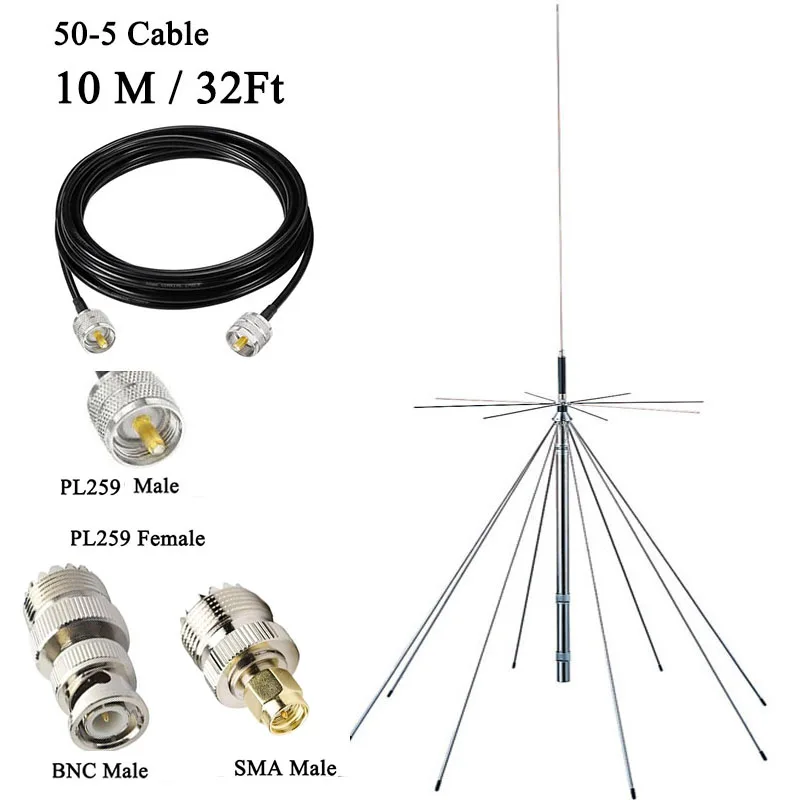
A discone hears a very wide range without retuning, which is what you want for a scanner or for browsing many bands. It is not better than a dipole on any one frequency, but it is never far off. Mount it outdoors and high, and check the connector in the listing: discones usually end in an N or SO-239 socket, so you need a coax lead and an adapter to SMA male.
SignalPlus D3000 discone antenna
RTL-SDR
A wideband discone listed for reception from 25 to 3000 MHz, sold with or without a cable. Check the connector on the listing and plan an adapter to SMA male for the stick.
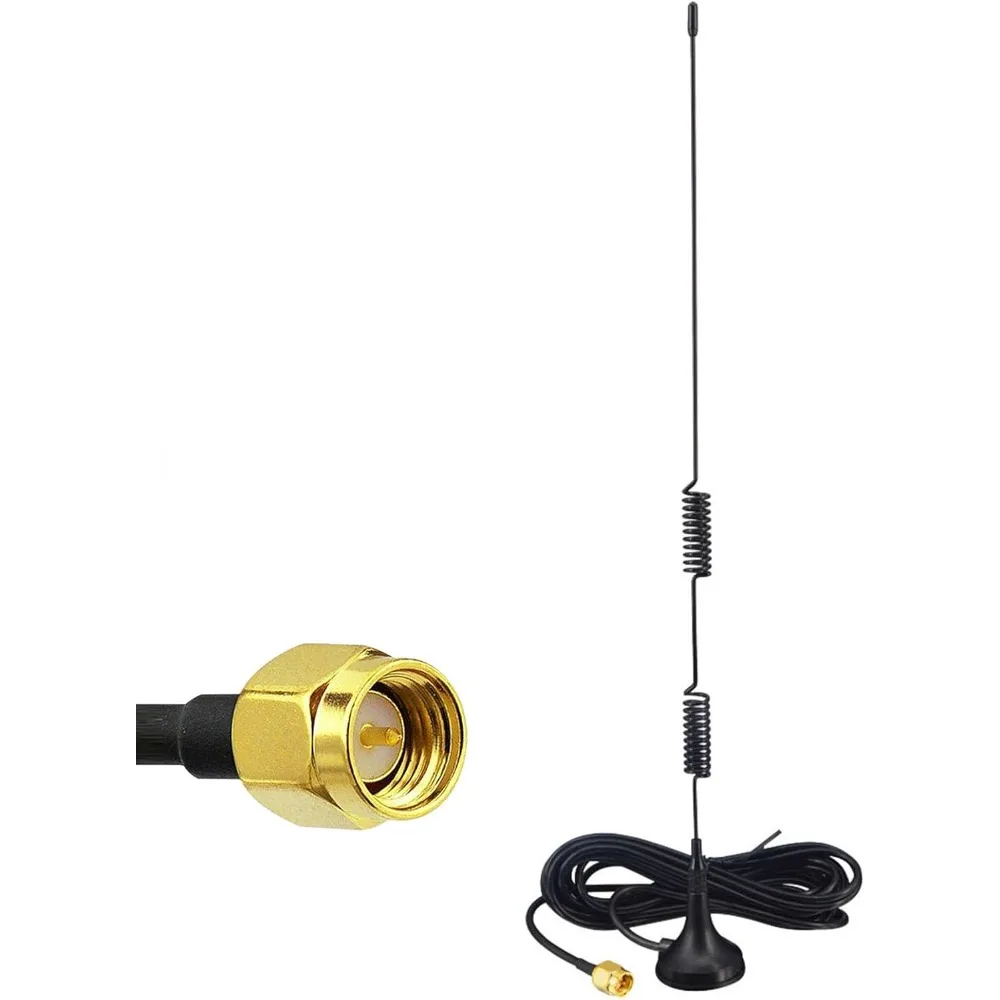
ADS-B replies from aircraft sit on 1090 MHz, where the kit dipole needs arms only about 7 cm long. A small antenna made for 1090 MHz on a magnetic base, by a window or outside with a clear view of the sky, adds a lot of range to the ADS-B decoder.
1090 MHz ADS-B antenna (SMA male, magnetic base)
RTL-SDR
A small antenna tuned for 1090 MHz with an SMA plug and a magnetic base, for the ADS-B aircraft decoder.
Strong FM broadcast stations can overload the stick and smear across the spectrum while you listen somewhere else; the app shows this as an Overload badge. A broadcast-band stop filter between the antenna and the stick takes 88–108 MHz out and leaves the rest. The V4 has notch filters built in, so it needs one less often than a V3.
An LNA (low-noise amplifier) helps only when a long coax run loses signal before it reaches the stick. Put it at the antenna end and power it with the stick’s 4.5 V bias-T, which the app switches on under Source after asking. Near strong transmitters an LNA makes overload worse, so try without one first.
RTL-SDR Blog FM broadcast stop filter (88–108 MHz)
RTL-SDR
Removes the FM broadcast band in front of the stick so strong FM stations stop overloading it. Fit it between the antenna lead and the stick.
A wideband low-noise amplifier powered over the coax by a bias-T, such as the one in the RTL-SDR Blog sticks. Worth it at the end of a long coax run, not next to a strong transmitter.